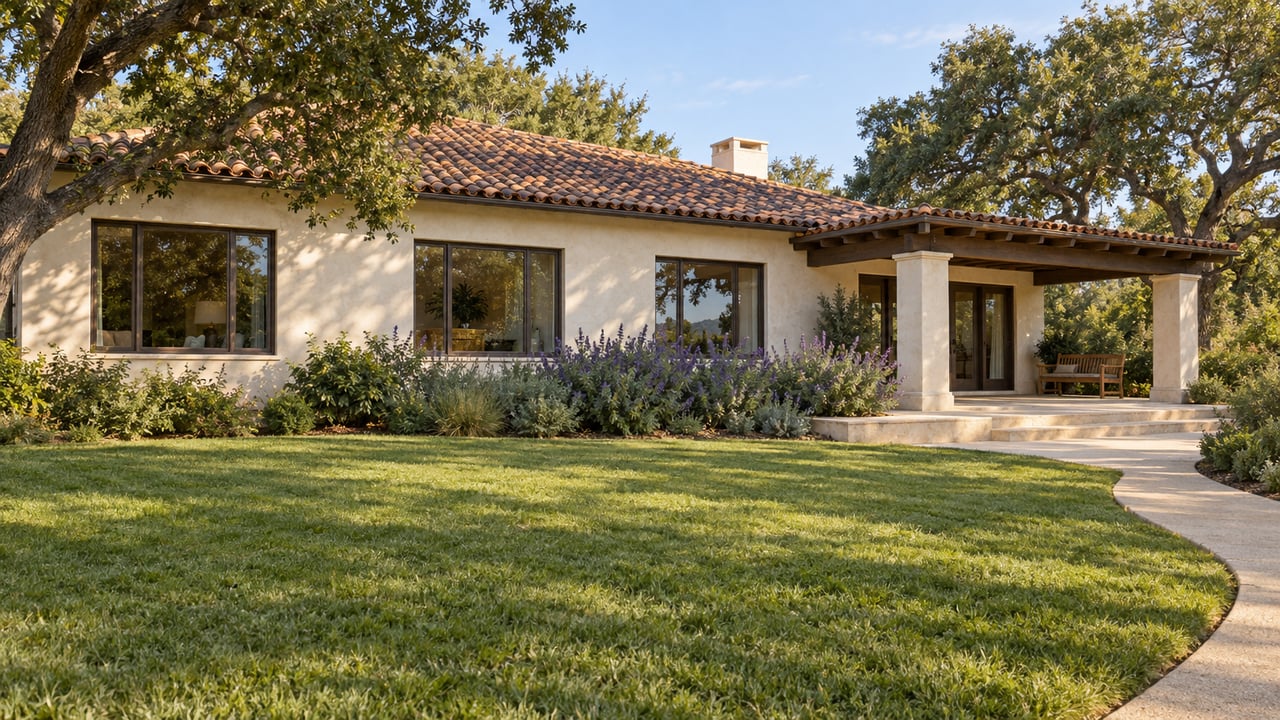
Why Two Santa Rosa Valley Acres Can Carry Very Different Water Bills
Two Santa Rosa Valley properties can share a road, a lot size and a price range and still cost very different amounts to irrigate each month. The reason is a water company that stopped existing in 2000. About 240 parcels in the western part of the valley get water from two systems: potable water for the house and cheaper non-potable water for the land. Most other parcels water everything from the potable system at up to $5.39 per unit as of the current rate year, which began in July 2026.
Listing sheets usually treat water as a utility rather than a feature. On land measured in acres instead of square feet, which pipe reaches the parcel may be the single biggest factor in what the property costs to hold.
Camrosa Water District has served eastern Camarillo and the Santa Rosa Valley since 1962. Its 2025 Urban Water Management Plan, finalized in July 2026, describes the event that split the valley into two kinds of parcels:
"In 2000, Camrosa absorbed the Santa Rosa Mutual Water Company, which had previously served a small pocket of customers in the Santa Rosa Valley in the center of the District's service area. Camrosa built new potable pipelines to serve the new customers and converted the existing distribution system to Camrosa's first non-potable water distribution system, supplied by local groundwater."
The old mutual's pipes became the irrigation line. The same plan counts about 240 parcels covering about 550 acres in the western portion of the valley with "dual service," meaning potable water for domestic use and non-potable surface water for irrigation. It describes the valley as rural-residential, with lots from 2 to 40 acres.
Today that irrigation water mostly comes from Conejo Creek. The creek carries treated water released from the Hill Canyon Treatment Plant in Thousand Oaks. Camrosa diverts it at the Conejo Creek Diversion Structure just south of the 101 and tops up the system with four untreated wells in the Santa Rosa Basin. Camrosa's water systems page says this network irrigates Leisure Village and "about 350 homes." That count is larger than the 240 parcels in the plan, and neither source explains the difference.
Camrosa's rate schedule, Ordinance 42-24, shows the size of the gap. From July 2026, potable residential water costs $4.70 per hundred cubic feet, or HCF, for the first 12 units and $5.39 for every unit after that. The "Non-Potable Residential Landscape (SRM)" rate is $2.40 per HCF. The ordinance doesn't spell out the initials, but given the history, SRM most likely stands for Santa Rosa Mutual.
Here is how that plays out in one illustrative summer month. Both parcels use 60 HCF in total, and both have a 1-inch potable meter. Lot A runs everything through the potable system. Lot B uses 12 HCF of potable water in the house and sends the other 48 HCF to irrigation on the non-potable line. For Lot B, we assume a 1-inch non-potable meter charge of $12.00 a month. These usage figures are an example, not a typical bill.
| Rate year | Lot A, potable only | Lot B, dual service | Monthly gap |
|---|---|---|---|
| July 2026 | $350.18 | $218.66 | $131.52 |
| July 2027 | $372.73 | $227.77 | $144.96 |
| July 2028 | $398.23 | $236.95 | $161.28 |
Both bills rise each year, but Lot A's rises faster, so the gap widens. Ordinance 42-24 was adopted on June 6, 2024, took effect July 1, 2024, and sets rates each July through 2028. Potable rates rise every year in that schedule. The non-potable residential landscape rate stays at $2.40 in every column from 2024 through 2028, and the non-potable meter charges stay flat too. A buyer can read the July 2027 and July 2028 prices today, because they are already adopted.
Owning acreage does not by itself earn an agricultural rate. Camrosa's FY 2026-27 budget says customers are classified "based on the primary use of water on their parcel," and that classification sets the per-unit rate. A parcel's class follows how its water is mainly used, not how many acres it covers.
The table above holds meter size constant. In practice it varies, and the fixed charge grows faster than the meter. These are Camrosa's monthly potable meter charges from July 2026:
A property on a 2-inch meter pays $103.21 a month more than one on a 3/4-inch meter before any water is used. That is about $1,238 over a year. By July 2028 the 2-inch charge is scheduled to reach $166.03. If a property also has a dedicated fire service line, the schedule lists $91.46 a month for sizes from 1 inch to 4 inches as of July 2026.
Combine a large meter with potable-only service and the cost difference between two otherwise similar valley properties reaches several thousand dollars a year. None of that shows up on a listing sheet.
Buyers may assume an existing pipe means non-potable service is available. In one part of the district, it does not. Camrosa's 2025 plan says some areas north of Upland Road have non-potable distribution infrastructure, but it is "not currently connected to any of the District's non-potable supply sources." As a result, those customers still get potable water.
Getting a new connection is not automatic either. Camrosa's non-potable service page says applicants need a service agreement and that applications are approved after a property inspection. A parcel next to dual-service land does not inherit that service. Whether a given property has a non-potable connection, or could get one, is a question for Camrosa about that specific parcel.
Sewer is the line a Santa Rosa Valley owner will not see. The UWMP says the valley lies entirely within unincorporated Ventura County and "relies on permitted septic systems for wastewater disposal." A valley water bill therefore carries no sewer charge, and the owner pays for septic upkeep directly.
The other possible charge is for groundwater. The Arroyo Santa Rosa Valley Basin Groundwater Sustainability Agency is a joint powers authority of Camrosa and the County of Ventura. Its stated purpose is to bring the Santa Rosa Basin to sustainability by 2042, and the Department of Water Resources approved its plan on April 28, 2025. Camrosa now pays for the agency's administration on its own.
A June 2025 budget memo named extraction fees and replenishment fees as possible long-term funding sources and set aside $50,000 for a pumping-fee rate study. The agency's June 23, 2026 budget memo again describes the study as being started and gives no fee amount. The September 22, 2026 agenda covered a conflict-of-interest ordinance and annual reporting, not a fee. None of these documents sets a rate or says which wells a future charge would cover.
Water costs in this valley come down to the parcel's specific connections, and those can be confirmed during escrow:
With those bills in hand, you can run the table above using the property's real numbers.
No. Camrosa's 2025 plan puts dual service at about 240 parcels in the western portion of the valley. Parcels elsewhere water their land from the potable system.
No. Ordinance 42-24 already sets the July 2027 and July 2028 rates. For example, Tier 2 potable water goes to $5.67 per HCF in July 2027 and $6.01 in July 2028.
The groundwater agency has a pumping-fee rate study in its budget. Its September 22, 2026 agenda listed no fee item, and its posted documents set no rate and do not say which wells a future fee would cover.
This post is general information, not legal, tax or financial advice. Please confirm rates, service status and any fees for a specific parcel with Camrosa and the right professionals.
If you are comparing acreage in Santa Rosa Valley, I'm glad to look at a property's water bills with you and work out what it will cost to hold over the next few rate years, so you know before you write an offer. Visit Julia Kanesawa to schedule your complimentary consultation.
Discover a seamless real estate experience with Julia Kanesawa, where expertise and dedication come together to achieve your goals. Partner with Julia for tailored guidance, market insight, and a refined approach to buying or selling your home.